Workers in Other Languages
The Milvaion scheduler runs on .NET, but workers don't have to. Besides the .NET worker SDK, Milvaion has worker SDKs for Node.js, Go, Python, Java and PHP.
A worker built with one of them works like a .NET worker:
- It registers itself and appears on the dashboard.
- It receives the jobs scheduled for it.
- It streams its logs live.
- Failed jobs are retried with exponential backoff, then moved to the dead letter queue.
- Jobs can be cancelled from the dashboard and are stopped by timeouts.
- On shutdown it lets running jobs finish and returns the rest to the queue.
The Workers page shows each worker's language next to its name, so a mixed fleet stays readable at a glance. Expand a worker to see its runtime and SDK version.
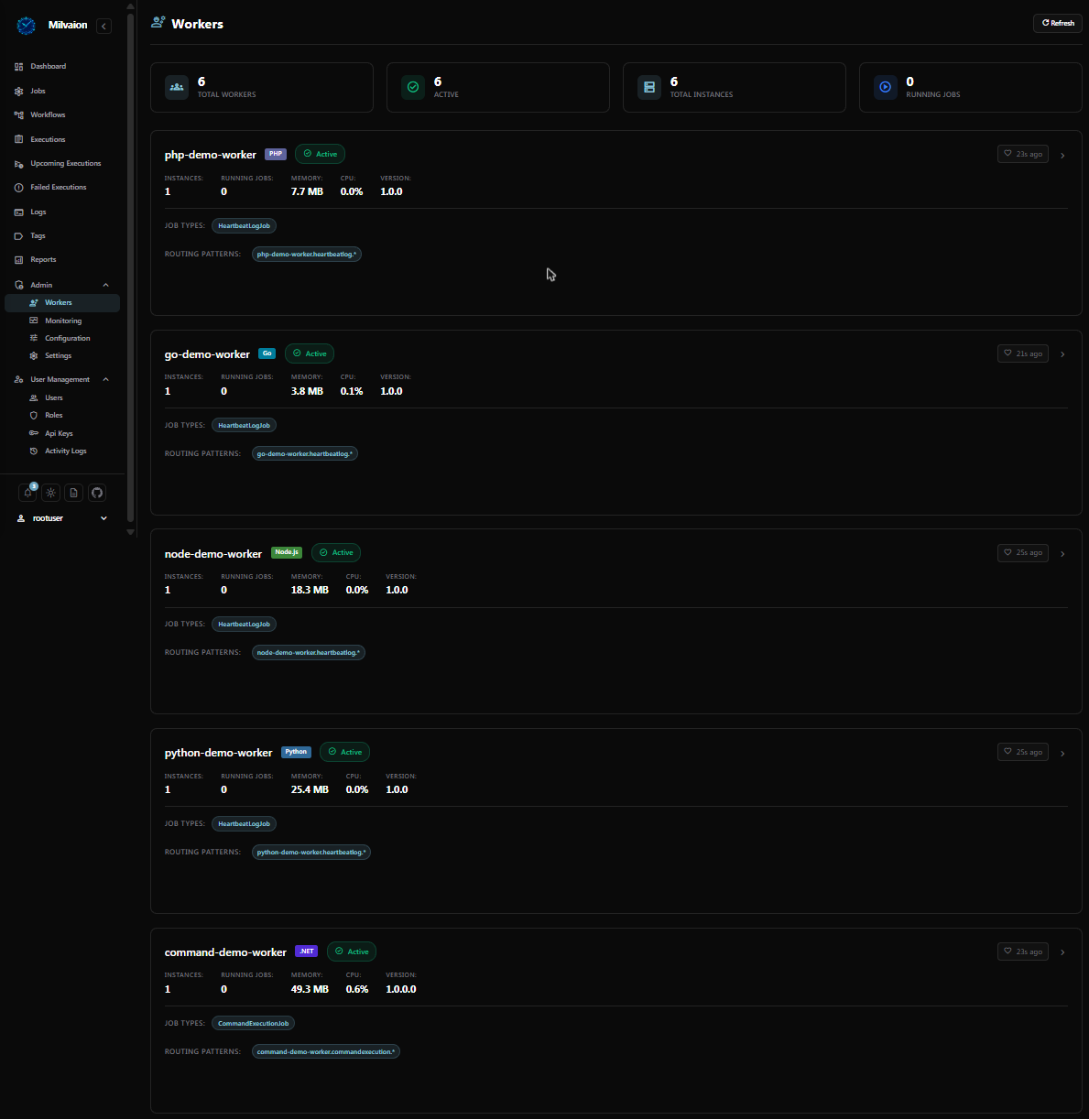
All of them speak the same worker protocol. That document describes the RabbitMQ queues and message formats, so a worker in any other language can be written against it too.
| Language | Requires | Package | Source and full reference |
|---|---|---|---|
| Node.js | Node.js 20+ | npm @milvasoft/milvaion-worker | sdks/node/milvaion-worker |
| Go | Go 1.24+ | github.com/Milvasoft/milvaion/sdks/go/milvaion | sdks/go/milvaion |
| Python | Python 3.10+ | PyPI milvaion-worker | sdks/python/milvaion-worker |
| Java / Kotlin | Java 17+ | Maven Central com.milvasoft:milvaion-worker | sdks/java/milvaion-worker |
| PHP | PHP 8.2+ | Packagist milvasoft/milvaion-worker | sdks/php/milvaion-worker |
The Command Worker runs scripts and programs in any language as Milvaion jobs, with live output, retries, cancellation and timeouts, without an SDK.
How a Job Ends
The rules are the same in every language:
| The handler... | Outcome |
|---|---|
| returns a value | Completed. A string is stored as the result as-is; anything else is stored as JSON. |
| fails | Retried with exponential backoff (3 retries, starting at 5 s, by default). After the last retry the occurrence is Failed and the job goes to the dead letter queue. |
| fails with a permanent error | Failed without retrying, and the job goes to the dead letter queue. Use this for invalid data and rejected business rules. |
| runs past its timeout | TimedOut |
| is cancelled from the dashboard | Cancelled |
| is still running when the worker stops | Goes back to the queue and runs again |
Delivery is at least once. A job whose worker crashes runs again, so make handlers idempotent. Every SDK exposes the occurrence id, which stays the same across retries, as an idempotency key.
Node.js
npm install @milvasoft/milvaion-worker
import { MilvaionWorker, PermanentJobError } from '@milvasoft/milvaion-worker';

const worker = new MilvaionWorker({
  workerId: 'mail-worker',
  rabbitmq: { url: 'amqp://guest:guest@localhost:5672' },
  redis: { url: 'redis://localhost:6379' },
});

worker.addJob<{ to: string }>('SendEmailJob', async ctx => {
  if (!ctx.data?.to)
    throw new PermanentJobError('Job data needs "to".');

  ctx.log(`Sending to ${ctx.data.to}`);
  await sendMail(ctx.data.to, { signal: ctx.signal }); // aborted on cancel, timeout or shutdown

  return { sent: true };
});

await worker.start();
process.once('SIGTERM', () => worker.stop().then(() => process.exit(0)));
Go
go get github.com/Milvasoft/milvaion/sdks/go/milvaion
worker, _ := milvaion.NewWorker(milvaion.Options{
	WorkerID:    "mail-worker",
	RabbitMQURL: "amqp://guest:guest@localhost:5672/",
	RedisURL:    "redis://localhost:6379",
})

worker.Handle("SendEmailJob", func(ctx context.Context, job *milvaion.Job) (any, error) {
	var data struct{ To string `json:"to"` }
	if err := job.Bind(&data); err != nil {
		return nil, err
	}
	if data.To == "" {
		return nil, milvaion.Permanentf(`job data needs "to"`)
	}

	job.Logf("Sending to %s", data.To)
	if err := sendMail(ctx, data.To); err != nil { // ctx is cancelled on cancel, timeout or shutdown
		return nil, err
	}
	return map[string]bool{"sent": true}, nil
})

ctx, stop := signal.NotifyContext(context.Background(), os.Interrupt, syscall.SIGTERM)
defer stop()
worker.Run(ctx) // returns after a graceful shutdown
Python
pip install milvaion-worker
from milvaion import JobContext, PermanentJobError, Worker

worker = Worker(worker_id="mail-worker",
                rabbitmq_url="amqp://guest:guest@localhost:5672/",
                redis_url="redis://localhost:6379")


@worker.job("SendEmailJob")
async def send_email(ctx: JobContext) -> dict:
    if not (ctx.data or {}).get("to"):
        raise PermanentJobError('Job data needs "to".')

    ctx.log(f"Sending to {ctx.data['to']}")
    await send_mail(ctx.data["to"])  # cancelled on cancel, timeout or shutdown

    return {"sent": True}


worker.run()  # SIGINT/SIGTERM shut down gracefully
A handler can be async def or a plain function. Plain functions run in a thread and should check ctx.raise_if_aborted() in long loops.
Java
<dependency>
  <groupId>com.milvasoft</groupId>
  <artifactId>milvaion-worker</artifactId>
  <version>1.0.0</version>
</dependency>
With Gradle: implementation("com.milvasoft:milvaion-worker:1.0.0").
MilvaionWorker worker = new MilvaionWorker(new WorkerOptions()
        .workerId("mail-worker")
        .rabbitMqUri("amqp://guest:guest@localhost:5672/")
        .redisUri("redis://localhost:6379"));

worker.job("SendEmailJob", ctx -> {
    EmailData data = ctx.data(EmailData.class);

    if (data == null || data.to() == null)
        throw new PermanentJobException("Job data needs \"to\".");

    ctx.log("Sending to " + data.to());
    mailer.send(data); // the thread is interrupted on cancel, timeout or shutdown

    return Map.of("sent", true);
});

worker.run(); // SIGTERM or Ctrl+C shut down gracefully
PHP
composer require milvasoft/milvaion-worker
$worker = new Worker(new WorkerOptions(
    workerId: 'mail-worker',
    rabbitMqUrl: 'amqp://guest:guest@localhost:5672/',
    redisUrl: 'redis://localhost:6379',
));

$worker->job('SendEmailJob', function (JobContext $ctx): array {
    $data = $ctx->data() ?? [];

    if (empty($data['to'])) {
        throw new PermanentJobException('Job data needs "to".');
    }

    $ctx->log("Sending to {$data['to']}");
    $mailer->send($data);

    return ['sent' => true];
});

$worker->run(); // SIGTERM or Ctrl+C shut down gracefully
A PHP process runs one job at a time; run more processes for parallelism. With ext-pcntl (standard on Linux), each job runs in a forked child that the worker kills on cancel or timeout, so heartbeats keep going during long jobs.
Configuration
Every SDK takes its options in code, or reads them from the same environment variables:
| Variable | Meaning |
|---|---|
MILVAION_WORKER_ID | Worker id. Use the same value on every replica. |
MILVAION_RABBITMQ_URL | RabbitMQ connection URL |
MILVAION_RABBITMQ_QUEUE_TYPE | classic or quorum. Must match the API's MilvaionConfig:RabbitMQ:QueueType. |
MILVAION_REDIS_URL | Redis URL for cancellation requests. false disables cancellation. |
MILVAION_REDIS_KEY_PREFIX | Must match the API's MilvaionConfig:Redis:KeyPrefix |
MILVAION_MAX_PARALLEL_JOBS | Capacity reported for the instance |
MILVAION_EXECUTION_TIMEOUT_SECONDS | Default job timeout |
MILVAION_HEARTBEAT_INTERVAL_SECONDS | Heartbeat interval |
Per job, you can set:
- the number of parallel executions
- the timeout
- retry count and base delay
- a JSON Schema for the job data, which the dashboard turns into the job data form
The job name you register is the name you select in the dashboard when creating the job. It is matched case-insensitively.